“We have no members – we are a community.”
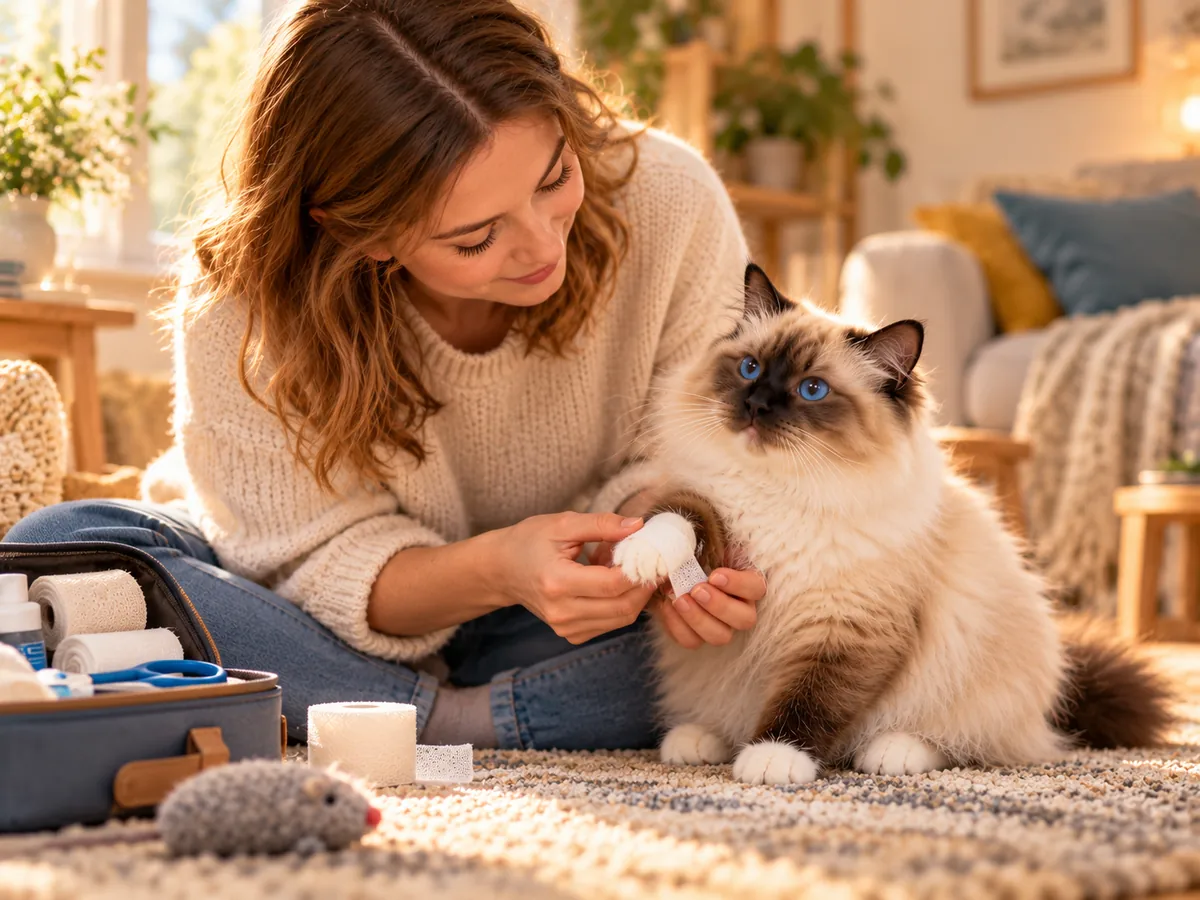
Omsorg for en Hellig Birma ved førstehjælp
Illustration for the topic – not a photograph or a historical source.
Front · Health · First aid
✚ NEW GUIDELINES · 2025/2026

First aid for the cat

Omsorg for en Hellig Birma ved førstehjælp
Sacred Birman · PROFESSIONAL UNIVERSEFirst aid for the cat

First aid · quick action

When something suddenly goes wrong, the goal is not to “treat at home.” The goal is to do the right thing in the first few minutes, avoid old home remedies – and get the cat safely to the vet.

Updated after RECOVER. The first aid guidelines for dogs and cats were published on August 25, 2026, and neonatal resuscitation for kittens and puppies was updated in 2025.
FOR THE PET OWNER

The first minutes

First: make sure the place is safe for you. A cat in pain or panic may bite and scratch. Call your vet/on-call vet early and use a speakerphone so you can keep your hands free.

☎
First aid should never delay transport to the vet.In case of collapse, severe shortness of breath, choking, cardiac arrest, poisoning, severe bleeding or severe burns: seek emergency veterinary help.

Unconscious and no regular breathing

NEW 2026: Start chest compressions first – within 10 seconds. Use the phone on speaker while calling for help.

Lay the cat on its side on a firm surface. Cats can be compressed with one hand around the chest or with the heel of the hand over the heart and supported on the back.

100–120/min1/3–1/2 chest width30 : 2

After 30 compressions, give 2 mouth-to-nose breaths if it is safe to do so. If giving breaths poses a risk to you, compressions alone are better than no CPR.

Choking/foreign body

NEW 2026: Up to 5 firm back strokes are the first choice for an awake cat.

Strike the upper back of the chest next to the spine – not directly on the spine. If this does not work, another suitable technique can be tried and then the back blow again.

Do not blindly put your fingers into the mouth of an awake cat. If the cat becomes unconscious, start chest compressions immediately.

Even if the foreign body comes out, the cat should be evaluated urgently by a veterinarian.

Heatstroke

Immediately move the cat to a cooler environment and stop activity. Begin active cooling before transport if safe.

Brug cool running water on the body so that the water reaches the skin. Avoid ice water.

Stop active cooling approx. 39.7–40.0 °C

Then transport the cat to the vet immediately – even if it seems better.

Combustion

Cool a thermal burn with cool running water for at least 20 minutes – as soon as possible and within the first 3 hours.

Do not use ice directly on the skin. For chemical substances, protect yourself, remove dry material carefully, and rinse thoroughly if safe to do so.

Suspicion of poisoning

NEW 2026: Do not routinely induce vomiting at home – and do not use hydrogen peroxide as a “home remedy”.

Call your veterinarian/on-call veterinarian immediately. Have the substance or product, approximate amount, time, cat's weight and symptoms ready. Bring packaging or photo.

Suspected low blood sugar

In a cat at risk – for example, an insulin-treated cat or a very small kitten – lethargy, staggering, collapse or seizures may be due to hypoglycemia.

If the cat not having cramps, a small amount of viscous simple sugar (e.g. honey/glucose syrup) can be applied to the cheek mucosa while the veterinarian is contacted.

Never pour liquids down the throat of an affected cat, and do not give anything by mouth during seizures.

Heavy bleeding

Apply firm, direct pressure to the wound with clean gauze or cloth and maintain pressure. Do not constantly lift the material to check.

For life-threatening bleeding from the leg or tail that cannot be stopped by direct pressure, a wide tourniquet may be a last resort. This should only be done if it can be done safely and the cat should be taken to the vet immediately.

Tourniquets are not used on the head, neck, chest or abdomen.

Shortness of breath, collapse and severe trauma

Open-mouth breathing, bluish mucous membranes, pronounced exertion, collapse or major trauma are always acute. Keep the cat calm, handle as little as possible and transport immediately.

First aid should not delay veterinary care. A cat in pain or panic may bite and scratch.
FOR THE BREEDER

Birth and newborn kittens

Neonatal resuscitation is not just “mini-CPR.” In the newborn, oxygen deprivation and lack of lung expansion are often the central problem, so ventilation and temperature control play a much greater role than in an adult cat.

🐾
The short mnemonicDry · stimulate · clear airway · keep warm · ventilate early if necessary · never swing.
1

Dry, stimulate and keep warm

Remove the membranes from the face. Wipe with a clean, warm towel and rub gently. Aim for normothermia around 35–37.2°C.

2

Never swing the kitten

RECOVER advises against “oscillating”: it can cause trauma, aspiration and delays effective ventilation.

3

Ventilate early if necessary

A limp, gasping or inadequately breathing kitten should have a clear airway. For a lot of fluid, brief, gentle suctioning can be used – and should not delay PPV.

4

CPR is different than in adults

Compressions are started when there is no heartbeat or when HR <50/min does not improve after 30–60 seconds of effective ventilation.

4chest compressions
:
1injection
Omsorg for en Hellig Birma ved førstehjælp
AI illustration

The heart rate controls the escalation

Hos en non-viable newborn with a clear upper airway, positive pressure ventilation is recommended at a heart rate below 120/minIf there is no heartbeat, CPR is started without delay.

Chest compressions are performed with one or two fingers above the heart, approximately 1/3–1/2 of the width of the rib cage, ved 120–150/min.

Mask ventilation and heart rate assessment should be learned practically by a veterinarian or on a neonatal/RECOVER course before birth.

Se på hele katten
Explanatory graphics

Routine suctioning is not the goal

A healthy kitten can usually clear fluid from the upper respiratory tract on its own. Wipe away any visible fluid around the nose and mouth.

In a non-viable kitten with a lot of fluid, brief, gentle nasal/oropharyngeal suctioning may be considered, but it should be immediately followed by ventilation and must never delay it.

Omsorg for en Hellig Birma ved førstehjælp
AI illustration

Hypoglycemia and cold are often linked

A kitten that is not nursing, losing heat or is lethargic should be assessed as a whole: temperature, weight gain, hydration, breathing and the cause of the lack of well-being.

If low blood sugar is suspected, sugar on the mucosa may be relevant, but it does not replace warmth, nutrition, ventilation or veterinary care.

Omsorg for en Hellig Birma ved førstehjælp
AI illustration

Birth preparation before term

  • Veterinarian and on-call veterinarian saved in the phone.
  • Transport plan and possibility of emergency cesarean section.
  • Clean hot towels, precise gram weight and safe heat source.
  • Suitable suction ball if you are trained in its use.
  • Neonatal mask/resuscitator only if you have learned the technique.

The most important equipment is a plan you have already practiced.

Important difference: Adult cat without regular breathing follows 30:2. Newborn kitten requiring CPR follows 4:1 with bag-mask ventilation. Do not mix the two algorithms.

Academic basis

This page is written for cat owners and breeders and is based primarily on RECOVER's evidence- and consensus-based guidelines. It does not replace veterinary judgment or practical training in CPR/ventilation.

Professionally updated: October 4, 2026. The page will be updated with new guidelines.