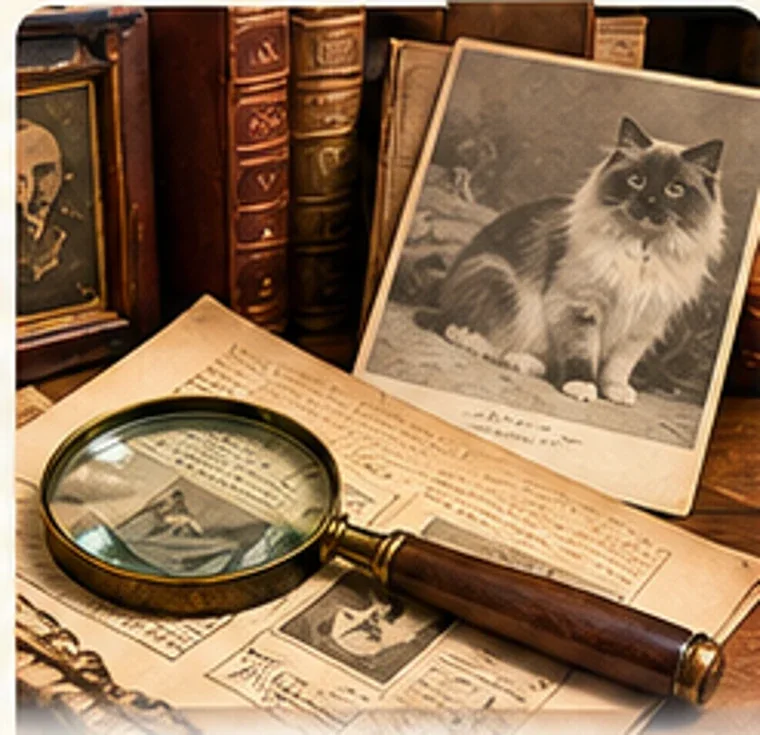
A name in a later book is a lead. A contemporary stud book, catalogue or dated photograph is documentation. The history project therefore records both the source and the precise information it actually supports.

The history must be verifiableStud books, catalogues, photographs and contemporary texts are the foundation of Birmakredsen’s history project.
♛
Important source collections
Sources with public documentation
Here we only show sources where there is a specific, publicly available reference. A link to an institution's homepage does not in itself document a specific historical piece of information.
Bibliographically documented

Philippe Jumaud · Les races de chats (1925)
Bibliographic record of Philippe Jumaud's 1925 thesis at the Université de Lyon, published by Édition des Tablettes. The catalogue entry documents the publication but is not a digitization of the entire book.
See original registration ↗Sources for health, genetics and well-being → · Historical Birmans →
How we work with a piece of information
- Find the earliest possible source.
- Record exact spelling, date, owner/breeder and relationships.
- Compare with independent sources.
- Preserve disagreement when the sources cannot be reconciled.
- Update the database and research notes with a source reference.
Credits
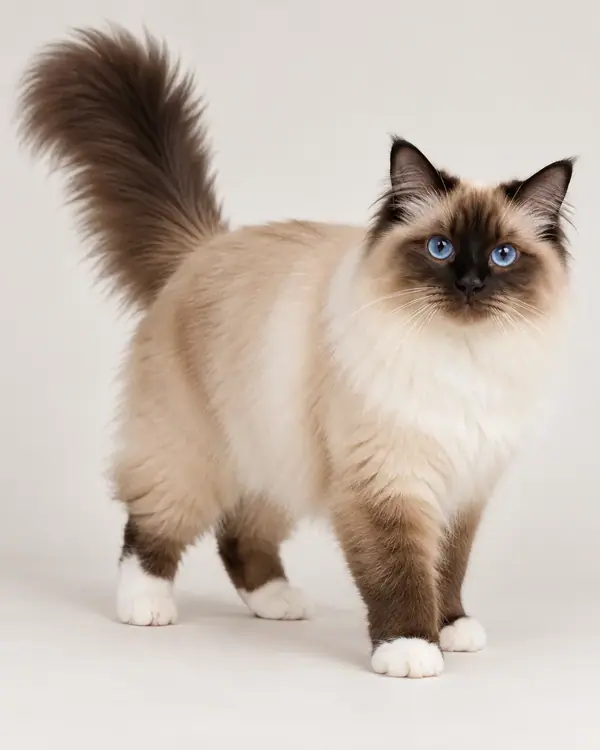
We credit the archives, libraries and contributors who make material available at the individual published sources. Material is reproduced only with due regard to rights and agreements.
?
If you have an old Birman pedigree, catalogue, photograph or book from before 1970, please contact us. Even a single name or catalogue number may connect two parts of the history.

Source register and research status
For each new original source, we should record: source ID, institution/collection, signature or catalog number, document date, page number, original spelling, affected cats regardless of breed, document type, rights, direct link, and what claim the source actually supports.
Status: Registreret (material has been received), Transskriberet (text is read), Kontrolleret (the information is compared with the original) and Uafklaret (conflicting or uncertain identification). One source can support multiple cats, and all historical records are preserved – including breeds other than the Sacred Birman.
Se the historical cat profiles og forskningsoversigtenOriginal documents are only displayed publicly when rights and personal data permit.
From original source to historical profile
Source references should, where possible, include the archive, document title, date, page number or registration number, and any alternative names. Information from other breeds is retained in the research material, even when public dissemination focuses on the Holy Birman.