Birmakredsen’s history project reconstructs the breed’s history from primary sources. The aim is not to repeat the best-known story, but to investigate what can actually be documented – and to clearly mark what we still do not know.

Knowledge is only power when it is shared.
History does not belong to the person who finds it. It belongs to all of us.
Birmakredsen’s historical work is based on a simple principle: sources, pedigrees, photographs, show catalogues, archival discoveries and new connections should not be hidden away, but shared, documented and open to verification by others.
Much of the breed’s early history has been repeated for decades. When we return to contemporary sources, original stud books and archives, the story often proves to be both more nuanced and more fascinating.
The work is not finished simply because something has been published. New discoveries can change what we thought we knew, and earlier conclusions can be corrected when new sources emerge.
We credit the people, archives, libraries and researchers who help open the material, and we cite our sources so others can follow the trails for themselves.
The aim is not to own the history. The aim is to understand it, preserve it and share it.
History in practice
The history section is designed as a living research environment. The main entry points are gathered in visual cards linking articles, databases and sources.
The breed told through the discoveries that change its history
Here we collect longer articles about the cats, people and sources that shape our understanding of the Sacred Birman. The articles are updated when new primary sources change the picture.
Youyou, Timour and “Lynx du Laos”
How could “Laotian Lynx” end up in Timour’s position in modern pedigrees when Baudoin in 1931 links the name to Youyou – and LOS places Timour one generation later? The first article follows the error trail back to the sources.
Read the article →Primary sources first

We prioritise original stud books, show catalogues, contemporary books and journals, photographs and archival material. Later retellings are used as leads, but not as final proof when they can be checked against an earlier source.
Source criticism is part of the presentation. When two sources disagree, we do not hide the conflict. The database and articles should show what is certain, probable and still unresolved.
A research-based timeline

Philippe Jumaud can be documented as having been admitted to the École vétérinaire de Lyon. His later writings became highly significant to the early breed narrative.
The first French traces cluster around cats, shows, Jumaud’s publications and the cat-fancy circles of Paris, Lyon and southern France.
A documented pedigree line can be followed through Hiram-Roi, Poupée, Timour and Lon-Saito to Sinh de Saint Hubert.
The breed can be traced in France, Switzerland and Germany through stud books, show material, breeder names and contemporary publications.
The Danish FD material adds a major new source layer with thousands of names and early pedigrees now being registered systematically.
Some of the most important findings
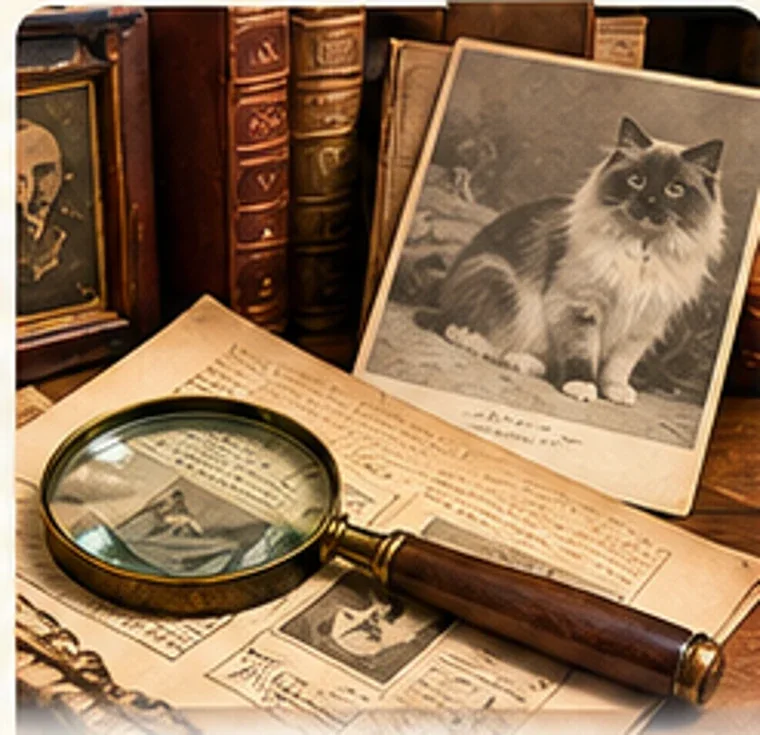
What we are still looking for

The project is not finished. We continue to look for complete catalogues from French shows in the 1920s and early 1930s, more Swiss and German registrations, individual CFA and GCCF traces and material that may illuminate the earliest Danish connections.

How to follow the research
Research changes as new contemporary sources emerge. Read the individual historical cat profiles together with kildeoversigten. Names, later reproductions and hypotheses must not be confused with documented identities.
The separate review of Youyou, Timour and »Lynx du Laos« brings together a central example of source-critical revision.
Further historical research
Historical names and identifications can be controversial. Always compare individual profiles with original sources, and distinguish between documentation, interpretation, and unconfirmed hypotheses.
Explore the history of Burma
Move from stories to sources, documentation and open research questions.
