A section of DNA that can influence a trait.
Bimse says:
I am seal point with white paws. That sounds simple. Then the humans discovered genes, and now they have spreadsheets. I recommend treats before the first Punnett square.
The short version: A kitten receives genetic material from both mother and father. Some traits show when only one particular variant is present; others require the same recessive variant from both parents. And every kitten is a new genetic draw – 25% does not automatically mean exactly one kitten in a litter of four.
A particular version of a gene – for example full colour or dilution.
What the cat carries genetically.
What we can actually see.
The most Birman-like feature first
Why is a Birman pointed?
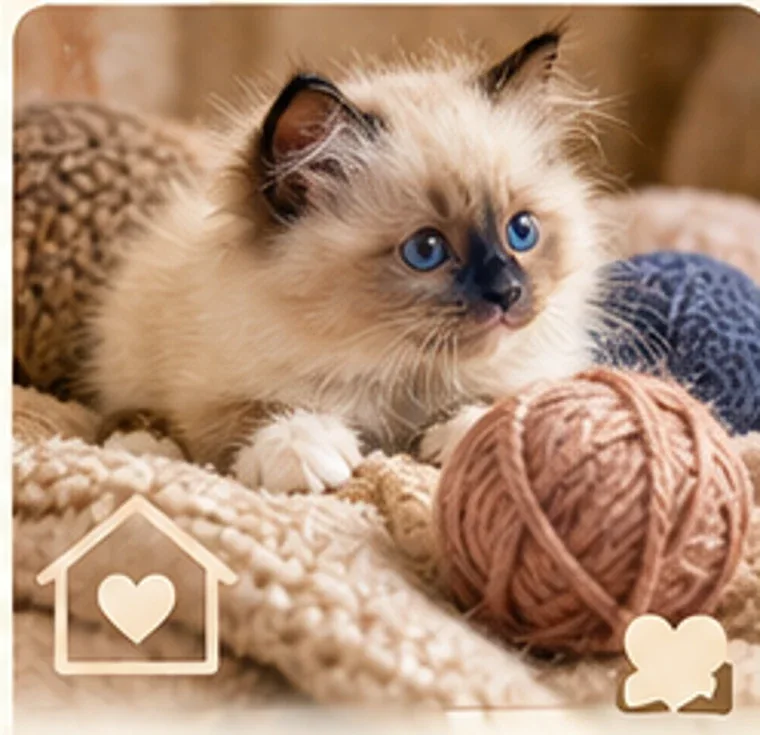
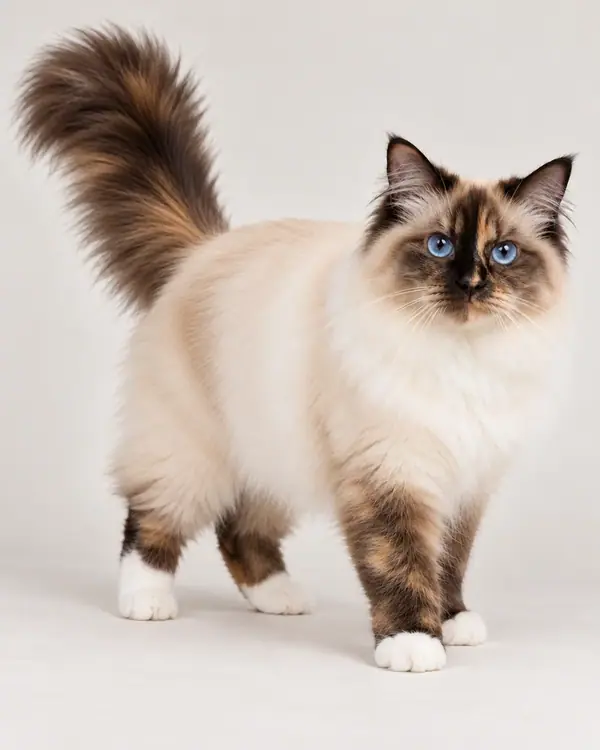
The Birman's point colour is caused by a temperature-sensitive variant in the TYR gene. Pigment production works best in cooler parts of the body, so the face, ears, legs and tail become darker than the body. This is also why Birman kittens are born very pale and develop clear points after birth.
The classic point variant is often written cs. A Sacred Birman with the normal breed phenotype carries two copies of the point variant. Two ordinary pointed Birmans therefore do not suddenly produce a fully coloured kitten.
In plain language: the mask is not a dark layer painted onto a light cat. The pigment system itself is temperature-sensitive.
Colours as building blocks
Seal, blue, chocolate and lilac
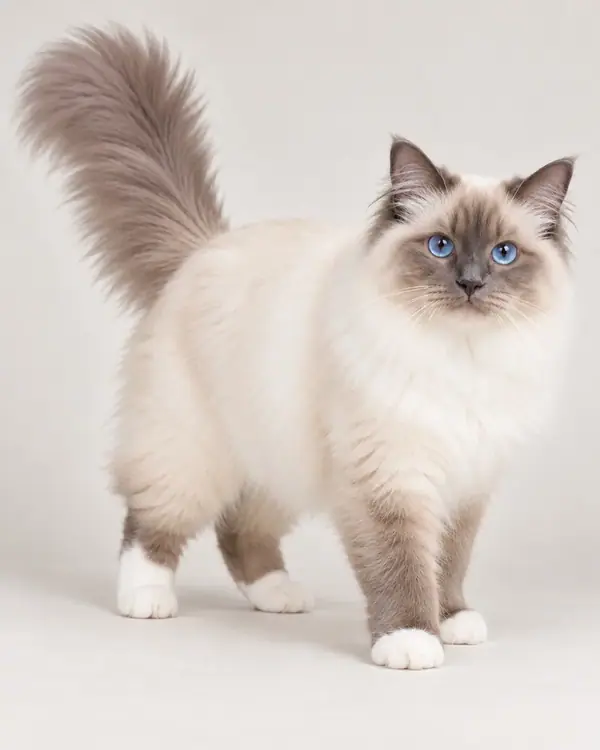
The four classic dark Birman colours can be understood through two questions: is the base colour seal or chocolate? and is it diluted?
Black pigment that appears dark brown in the points because of the point gene.
B/- D/-Seal with two copies of the dilution variant.
B/- d/dTwo chocolate variants at the brown locus. Chocolate is recessive to seal.
b/b D/-Chocolate that is also diluted.
b/b d/dDilution is recessive. A seal or chocolate Birman can therefore carry blue/lilac invisibly. Two carriers may produce dilute kittens even though neither parent is blue or lilac.
Remember: D/- means “at least one D”. You cannot tell by looking whether a cat is D/D or D/d; pedigree information or a DNA test can help.
The sex-linked gene
Red, cream and tortie
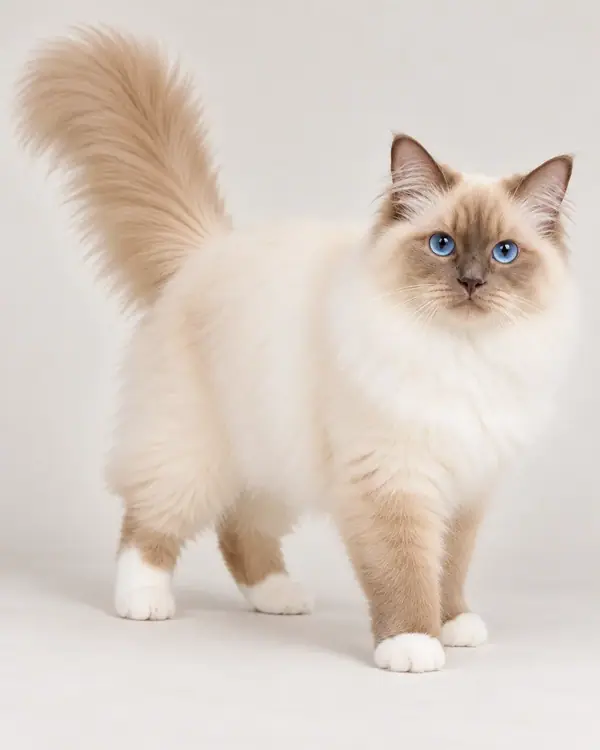
Red is the part of Birman genetics where sex really matters. Orange/red is carried on the X chromosome. A typical male has only one X and is therefore red/cream or non-red. A female has two X chromosomes and can carry one red and one non-red version – producing tortie.
A red male gives his X chromosome to all daughters, never to his sons. A son's only X comes from his mother. Tortie males do occur, but they are rare and usually involve unusual chromosome arrangements or mosaicism/chimerism; they are not the normal inheritance pattern used to plan a Birman litter.
Pattern on top of colour
Tabby, silver and smoke
Tabby is a pattern, not a base colour. The agouti system makes light and dark banding in the hair visible, creating clear striping in the points. A seal tabby and a blue tabby can therefore share the same pattern while having different base colours.
Red and cream cats can show obvious striping even when the classic agouti test does not tell the whole story, so appearance, pedigree and DNA may need to be read together.
Silver and smoke involve pigment inhibition that leaves the lower part of the hair paler. In Birmans this appears in the points as silver tabby or smoke. It is a good example of colour genetics being several layers, not one single “colour gene”.
The breed's white signature
The white gloves have their own genetics
Birman white feet are not simply ordinary white spotting. Research has identified a Birman-associated variant in the KIT gene that is inherited recessively. Most purebred Birmans carry two copies.
But the DNA test cannot tell you whether the gloves will be perfectly symmetrical, exactly how high they will reach or whether the gauntlets will be show-perfect. Other genetics and biological variation matter too.
The important bit: the variant helps explain why the Birman has white feet. It cannot order four identical gloves to the millimetre.
See the page on gloves & gauntlets →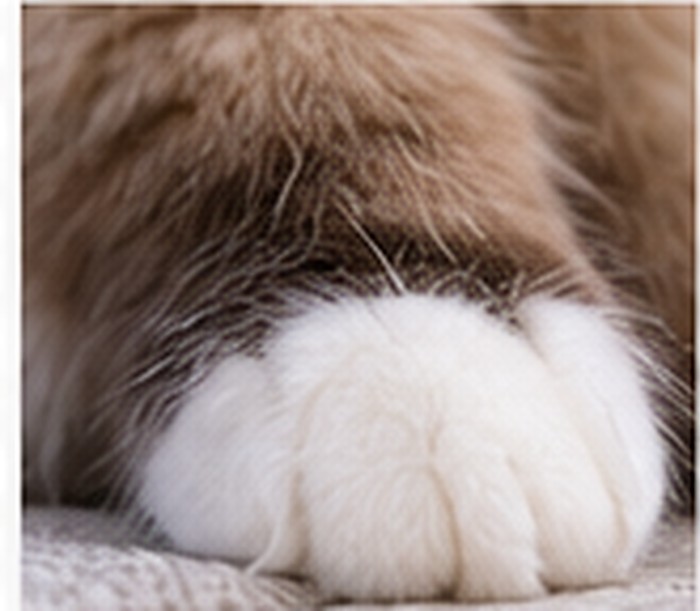
Try the logic

What can the kittens become?
These examples show one genetic trait at a time. In a real litter, all colour genes act together.
Seal carrying dilution × blue
If the seal parent is D/d and the blue parent is d/d, each kitten has a 50% chance of being non-dilute and a 50% chance of being dilute. Every non-dilute kitten will carry d.
Seal chocolate-carrier × seal chocolate-carrier
If both are B/b, the expected genotype split is 25% B/B, 50% B/b and 25% b/b. Phenotypically that is about 75% seal and 25% chocolate when other genes are ignored.
Red male × seal female with no red
The father gives his red X to every daughter, so the daughters are tortie. Sons receive Y from the father and their only X from the mother, so they are non-red. Base colour, dilution and tabby can still change the exact result.
Tortie female × seal male
A typical tortie female with one red and one non-red X can statistically produce 50% tortie and 50% non-red daughters; among sons, 50% red and 50% non-red. These are probabilities per kitten, not a litter order form.
What FIFe actually recognises

Birman colours in FIFe 2026
FIFe recognises seal, blue, chocolate, lilac, red and cream as pointed base colours, plus the relevant tortie, tabby, smoke and silver-tabby combinations. The breed's EMS code is SBI.
SBI n/a/b/c/d/eSBI f/g/h/j+ 21 tabby+ s smoke/silver
Cinnamon, fawn and other feline colours may be genetically interesting, but they are not FIFe-recognised Birman colours and are therefore not treated as Birman colours here.
See all colours with EMS codes →Health and breeding

Genetics is more than coat colour
Birmans may have blood type A, B or AB. Blood type matters for transfusions and breeding because a type-B queen carrying A/AB kittens can create a risk of neonatal isoerythrolysis.
Read about blood types →There is evidence for a heritable component to susceptibility in Birmans, but FIP is not a simple single-gene disease. Commercial “FIP resistance” genetic tests should not be used as the basis for breeding decisions.
Read about FIP →A DNA panel is only useful when the variant is genuinely validated and the result changes a sensible decision. A long test report is not the same as healthy breeding.
Genetics also means relatedness. Inbreeding, popular sires and loss of genetic diversity cannot be assessed by looking at one DNA variant.
Open the pedigree database →Detail: MPS VI – why two variants must not be confused
Some laboratories offer MPS VI testing for Birmans. The disease-associated L476P variant and the much more common D520N variant are not the same. D520N alone has not been shown to cause disease, and research has specifically warned against excluding Birmans solely because of D520N because this can unnecessarily narrow the gene pool.
Genetic diversity

“Clear of everything” is not a breeding goal
A healthy population needs variation. Removing every cat that carries a recessive variant can also remove a great deal of useful genetics. For an ordinary recessive disorder it is often much better to mate a carrier to a genetically clear cat and manage the next generation thoughtfully than to discard an entire line.
Birmakredsen therefore treats genetic test results as tools, not verdicts. Health, temperament, relatedness, fertility, longevity, clinical screening and the breed's total gene pool all matter.
A DNA test can …
- identify known variants for traits such as chocolate, dilution, point and Birman gloves
- reveal hidden carriers that cannot be seen from the coat
- support planned matings when the test is relevant and validated
- verify parentage when a proper parentage test is used
A DNA test cannot …
- predict perfect glove height or symmetry
- replace heart scans, clinical examinations or common sense
- tell the whole story about complex diseases such as FIP
- make a genetically narrow population healthy simply by removing “positive” results
Sources and scientific basis: FIFe Sacred Birman standard 01.01.2026; UC Davis Veterinary Genetics Laboratory on Birman, colourpoint restriction, dilute, brown, agouti and Birman gloves; peer-reviewed work on the KIT glove variant, feline genetic diversity, FIP susceptibility in Birmans, and current ABCD FIP guidelines. This page is educational material, not individual veterinary advice.
Last updated: 4 October 2026