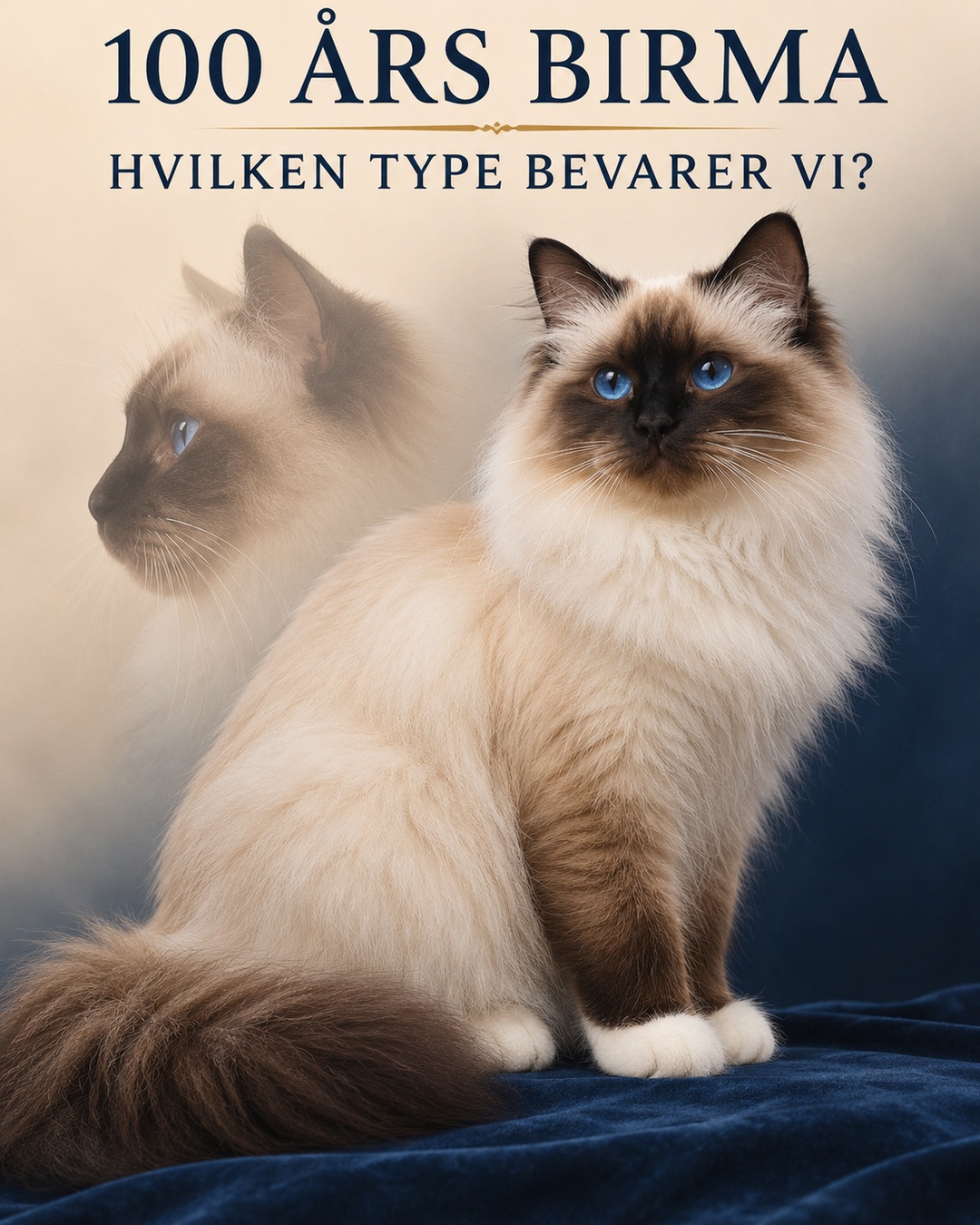
The Sacred Birman after 100 years: are we breeding away from its type?
An old ideal and a present-day question
The Sacred Birman was recognised in France in 1925. A century later, an important question deserves more than a discussion of taste: are we preserving the combination of traits that made this a distinct breed, or are some selection preferences pulling its appearance in another direction? A fuller head, shorter nose or more abundant coat may look impressive. Yet exaggerating a feature does not automatically make a cat more typical of its breed.
Siamese-related does not mean a simple recipe
The Sacred Birman is a blue-eyed colourpoint cat with historical connections to Siamese-related cats. That does not prove a single founding mating between a modern Siamese and a modern Persian. Historical breed labels were less fixed than today's, and post-war reconstruction involved outcrossing. The Birman historical archive illustrates why legend, plausible reconstruction and documented pedigree must remain separate. Our present question is not about blaming an ancestor; it is about the choices made by breeders today.
What the standard actually requires
FIFe's official Sacred Birman (SBI) standard describes a medium-sized cat with strong bone, a slightly rounded forehead, full and somewhat rounded cheeks, and a firm chin. The nose is of medium length, without a stop but with a slight indentation. Eyes are medium-sized, not quite round but slightly oval, and deep blue. Ears are rather small, rounded at the tips and well spaced. The body is slightly long, the legs short and strong, and the coat silky with little undercoat. White gloves and hind gauntlets distinguish the breed, but do not define its entire type. FIFe lists 2017 as the last modification to the SBI standard. This does not establish that its wording has remained unchanged since 1925; original early standards would need to be compared to make that claim.
How selection can shift the boundary
A written standard may remain relatively stable while the cats being rewarded change. This can happen gradually if a moderate feature is interpreted as one that should always be intensified: full cheeks become an increasingly round head; a slight indentation becomes a pronounced stop; a rich coat becomes a heavier, woollier one. These are possible mechanisms of selection, not evidence that all Birmans or judges are moving in this direction. That is precisely why photographs, judging preferences and breeding decisions deserve systematic examination rather than anecdote.
Persian-like is a description, not an accusation
By 'Persian-like' we mean visible features such as a shortened or compressed facial profile, a pronounced stop, a very rounded head or an unusually compact outline. We do not mean that an individual Birman has a recent Persian ancestor, nor that its breeder crossed breeds. Nor is this a criticism of the Persian breed. It asks whether traits suited to one breed's ideal should become the norm in another. FIFe may place the two breeds in the same show category, but each has its own standard.
Look at the profile and the moving cat
A frontal photograph with striking blue eyes may conceal a very short profile. Breed type therefore needs several views: nose length and nostrils, the forehead-to-nose transition, chin position, eye shape, ear proportions and body length. The cat should also be observed standing and moving. A profile should not merely photograph well; it belongs to a face that must breathe, eat and function normally. One picture or one show result cannot establish a population trend.
What would demonstrate a genuine trend?
We would need comparable photographs across decades, with known age, sex, angle and preferably pedigree; dated historical standards; and a systematic assessment of many cats rather than selected extremes. Such a study might establish whether nasal profiles, head shapes or body proportions have changed. Until then, the suggestion that the breed as a whole is becoming more extreme is a legitimate concern and a testable hypothesis, not a proven population-level finding.
Preservation also means restraint
Responsible selection does not mean freezing the breed in 1925. Health, genetic diversity, temperament and welfare must continue to be protected. But we should be prepared to reject exaggeration, even when it is fashionable or rewarded in the show ring. Breeders and judges can ask one question: are we rewarding the Sacred Birman's distinctive, harmonious whole, or simply maximising individual traits? Preserving the Birman does not mean creating a smaller Persian. It means allowing it to remain a Birman.
Sources and evidence limits
- https://fifeweb.org/wp-content/uploads/2023/10/SBI.pdf
- https://fifeweb.org/cats/breeds/
- https://fifeweb.org/2025/12/19/breed-standards-general-part-version-2026/
- https://www.gccfcats.org/getting-a-cat/choosing/cat-breeds/birman/
- https://birmakredsen.dk/historie.html
- https://birmakredsen.dk/standard.html
- https://birmakredsen.dk/velfaerd-en.html