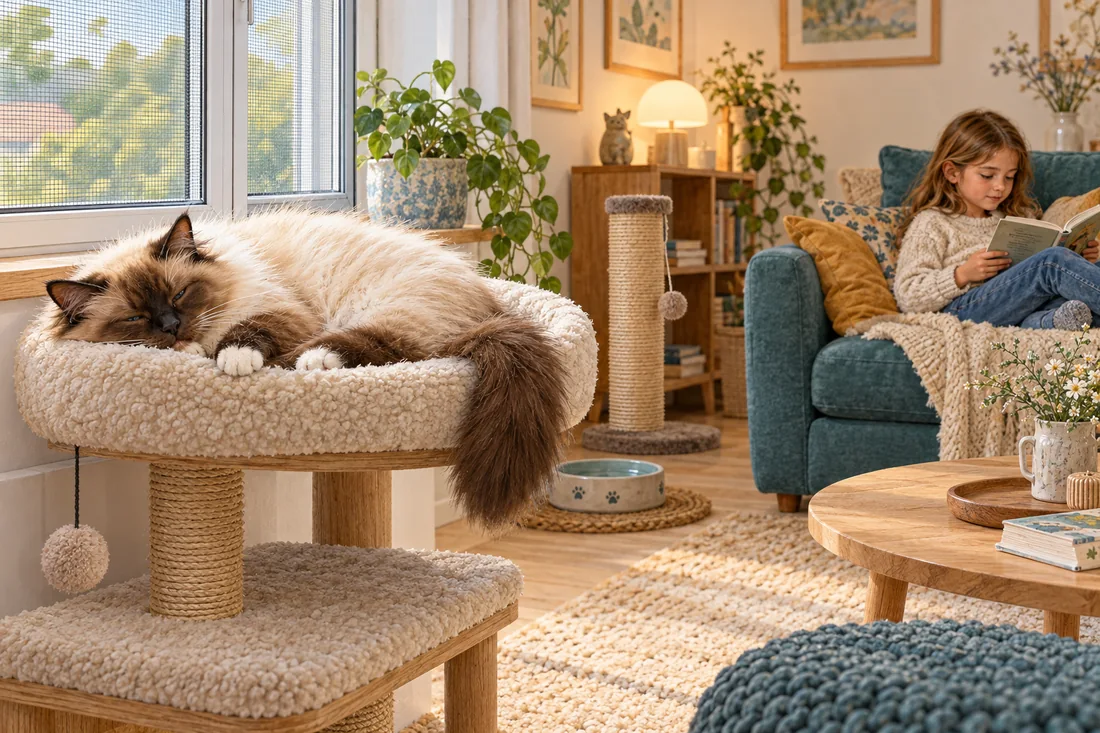
Illustration: Birmakredsen · not historical original photo
The cat first – from breed ideal to everyday life
About the texts: The Birmakredsen's welfare texts bring together the view that a good Birman should be able to live a good cat life. We look at both well-being, choices in breeding and the environment of the owner. The formulations are editorially reworked from previous topics and conversations; they are not presented as verbatim, documented published Facebook posts.
Episode 01 of 14
Well-being is more than the absence of illness
Featured image · Birmakredsen
A cat can be free of a proven diagnosis and still be unhappy. Welfare includes security, control over its own environment, appropriate activities, social relationships and the opportunity to withdraw. This applies to both the show cat, the breeding cat and the neutered couch cat.
When we measure welfare, we must look at the cat's own perspective. A good appearance or high ranking at a show cannot tell whether the cat is getting peace, care and appropriate challenges at home.
Don't just ask 'is it healthy?', but also 'does it have a good life?'.
Cats need safe hiding places, separate resources, opportunities for hunting-like play, predictable friendly human contact, and respect for their sense of smell. The five pillars are developed in professional cat welfare guidelines and also apply to Birmans.
You don't need a huge house. Several good resting places at different heights, clean trays, water in several places and short play breaks can make a big difference. Pay attention to what each cat chooses.
A well-functioning home is designed for the cat, not just for people.
The shape of the face is part of the breed type, but free breathing is more important than the ideals of fashion. Noisy breathing, reduced tolerance for activity, or repeated discomfort in heat should not be normalized as a cute breed characteristic.
A responsible assessment is about function, anatomical balance and the well-being of the individual cat. Avoid drawing conclusions from a single picture; watch the cat in motion and contact your veterinarian if there are any problems.
Healthy breed characteristics must be able to function – even when the cat is playing and sleeping.
Cats are built to stretch, balance, jump and play. A Birman who can no longer reach his favorite places or moves stiffly should be evaluated. Body build should not be bred to an ideal that makes normal movement difficult.
Adapt the home so that the cat can get up and down safely, especially as a senior. Several small steps or a lower climbing path can provide freedom without putting pressure on a sore joint.
Movement is part of well-being, not an extra luxury need.
Cats need to be able to choose between being on and off. Forced cuddling, repeated interruptions during sleep, and a lack of hiding places can make otherwise friendly cats feel insecure. The Sacred Birman's reputation for being contact-seeking does not negate its own limitations.
Create quiet zones, let the cat take the initiative and pay attention to small signals: head turned, tense body, tail wagging or attempts to walk away. Respect a no before the cat feels the need to hiss.
A 'no thank you' from the cat is communication, not disobedience.
Two cats can share a home without being good friends. Blocking a passage, staring, avoiding, tense body language or conflict over food and litter can be signs of social problems, even when there is no fighting.
Offer resources in multiple locations and avoid forcing the cats together. New cats are introduced gradually, and behavioral changes should also make us consider pain or other illness.
Lying in the same room is not the same as enjoying each other's company.
Kittens benefit from positive experiences with sounds, people and daily handling. But socialization is not a competition to expose a kitten to as much as possible. Too many impressions without the possibility of withdrawal can have the opposite effect.
Short, friendly meetings and a secure base create better conditions. Owners should continue the calm work after taking over without pressuring the cat for social contact.
Safe socialization is based on small successes and the opportunity for a break.
Breeding cats are cats first and foremost. They need adequate space, social contact, opportunities for rest, and a life where reproduction does not overshadow their well-being. A successful mating is not in itself proof that the breeding decision was a good one.
Look at fertility, births, recovery, temperament and general health before planning the next mating. A breeder should be able to say no or take a break when the individual cat needs it.
The ability to reproduce is never the same as an obligation to have kittens.
If an undesirable trait occurs frequently in a population, it may appear normal. This may include malpositioned teeth, breathing sounds, movement problems, or high stress. Prevalence does not make the problem harmless.
We should describe function and document findings, even when it challenges habits or exhibition ideals. It is a shared responsibility for owners, breeders, judges and organizations.
The question is not how common it is, but how the cat is affected.
A show provides an opportunity to meet others and receive a professional assessment, but the cat must never become a means to an end. Transport, noise, new smells and handling can be stressful for some cats.
Assess appetite, body language, and recovery before, during, and after the event. A cat that is repeatedly uneasy should not be pushed further for the sake of certificates. It may be the most responsible decision to stay home.
A cat-proof garden, balcony or aviary can provide fresh air, scents and space to experience the world, while limiting traffic and escape risks. A safe outdoor space should have shade, water, resting places and real access.
The Birmakredsen recommends a secure outdoor life rather than free range. Indoor life also requires stimulation and good resources; security alone does not create well-being.
Combine safety with sensory experiences and freedom of choice.
The senior cat has the right to the same quality of life
Featured image · Birmakredsen
Older cats often change habits, but pain, dizziness or poor appetite should not be simply written off as old age. Provide easy access to litter, food, water and warm resting areas, and talk to your vet if there are any changes.
Activation should continue at a pace the cat can follow. Short games, new scents, and human contact on the cat's terms still make sense late in life.
Senior life is not just about more years, but about good days.
Professional conversations about health and welfare can be sensitive, especially when they are about a breed we love. Good communication must be respectful, source-based, and willing to adjust old beliefs.
Criticism of a practice is not necessarily criticism of the people who have previously followed it. New information should be met with curiosity, and disagreement should not be tolerated.
Choose documentation and dialogue over personal attacks.
COI, test scores, weight, show ratings and average lifespan can contribute knowledge, but no single number fully describes welfare. The numbers should be used to help make better decisions, not to replace them.
A responsible overview combines data with observation of the cat's function, well-being and the real conditions it lives in. Conclusions must be able to be revised as new knowledge becomes available.
Here you will find the official or professional sources relevant to the topics of the series. They are not a source of private historical research findings. Updated rules always precede an older web text.