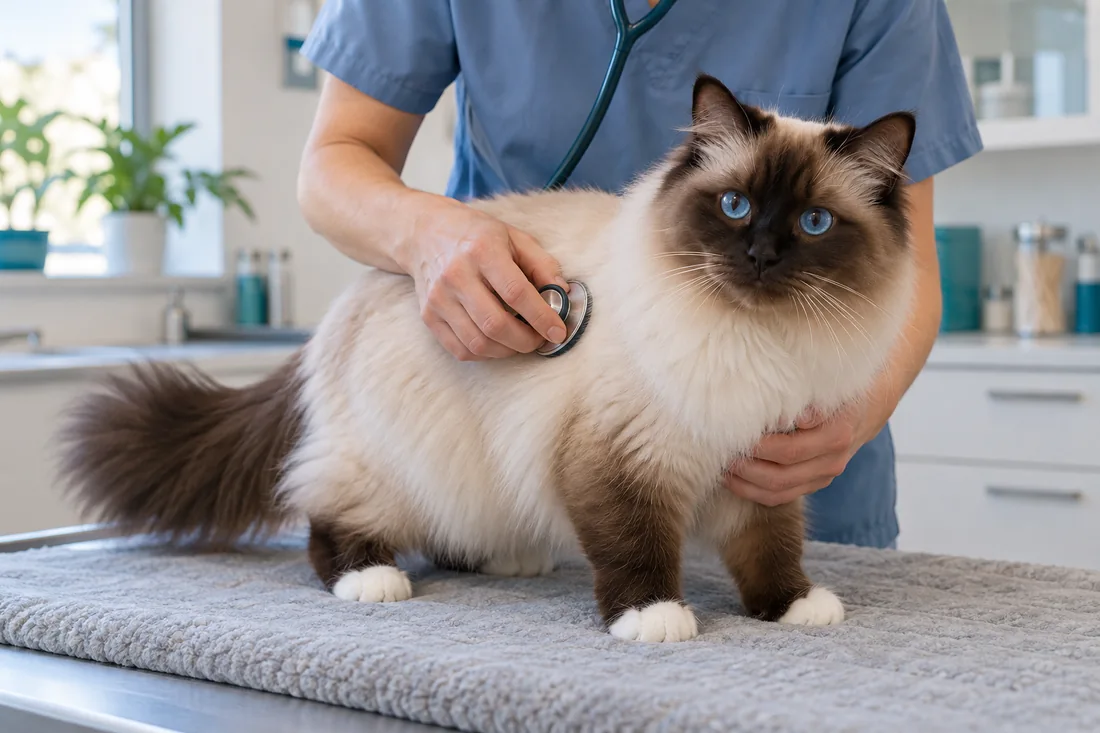
Illustration for the topic – not a photograph or a historical source.
Knowledge archive · Health
Health and veterinary knowledge
Sacred Birman · Health and veterinary knowledge
Prevention, symptoms, examinations and quality of life
About the texts: The health content is written for cat owners and breeders. It is not a diagnostic guide and does not replace the assessment of the treating veterinarian. In particular, in the event of acute symptoms, action must be taken quickly. The formulations are editorially reworked from previous topics and conversations; they are not presented as verbatim, documented published Facebook posts.
Important: Emergency info: In case of difficulty breathing, lack of urination, collapse, poisoning or serious injury, a veterinary emergency room should be contacted immediately.
Episode 01 of 20
What is the health of the Holy Birman?
Featured image · Birmakredsen
Health is much more than a negative DNA test result. It is also about the cat being able to breathe easily, move naturally, eat without pain and thrive mentally. Reproduction, immune system, freedom from pain and quality of life are other parts of the overall picture.
A healthy cat is not necessarily a cat without diagnosed problems today. Good health communication follows the cat through life and tells what we know, what we are watching for, and where knowledge is still insufficient.
Assess the cat as a living individual – not as a series of test results.
A natural movement pattern, free breathing, a well-functioning bite and a healthy body weight are fundamental. In the Sacred Birman, breed characteristics should never be used as an argument for ignoring difficulties with breathing, mobility or feeding.
Cats often hide their discomfort. Changes in jumping, grooming, appetite, activity level or contact seeking can be early signals. Note changes rather than waiting for dramatic symptoms.
Healthy body composition is a function – not just an appearance.
DNA tests can be very valuable when a well-described relevant mutation is found. However, a normal test does not rule out other hereditary diseases or non-genetic disorders. All tests must be understood in terms of what they actually measure.
For some diseases, clinical examination, scanning, laboratory tests or family history are more important than a single DNA sample. Therefore, health programs are best when the methods complement each other.
Always ask: What can the test detect – and what can't it detect?
Hypertrophic cardiomyopathy is a heart muscle disease that can also occur in cats without obvious symptoms. A heart scan by a qualified professional is a key way to assess the structure of the heart. A normal scan is a snapshot, not a lifelong certificate.
In case of difficulty breathing, sudden weakness or acute paralysis, the cat should be evaluated immediately. In terms of breeding, individual animal examinations should be viewed together with family information and veterinary advice.
Save results with date – and distinguish between current finding and future risk.
FIP is caused by feline coronavirus and is a serious disease. New antiviral options have significantly improved the treatment outlook. However, diagnosis remains complex and requires a comprehensive assessment of clinical signs, examinations and tests.
A cat with suspected FIP should be taken to a veterinarian with experience in diagnosis and modern treatment. Medication, dosage, control tests and access conditions must always be handled professionally and legally; owner prescriptions for treatment do not belong in a general posting.
FIP no longer automatically equals hopelessness, but requires prompt veterinary attention.
Chronic kidney disease is a major cause of illness, especially in older cats. Increased thirst, changes in urine output, weight loss, and decreased appetite may be signs, but are not specific to the kidneys. Diagnosis requires a veterinarian's evaluation and often several types of tests.
Blood and urine tests, blood pressure and weight curves can together provide a much better picture than one value alone. Treatment and feeding must be adapted to the individual cat's stage of illness.
Track your weight, appetite and desire to drink – without self-diagnosing.
Dental disease is common in cats and can be painful even when the cat is still eating. Bad breath, drooling, dizziness when chewing, or changes in eating habits may be reasons for an examination. Tooth resorption requires special attention from the veterinarian.
Home tooth brushing can be helpful when the cat is slowly acclimated to it, but it is not a substitute for a veterinary dental examination. X-rays and treatment may be necessary under anesthesia after professional assessment.
The cat should not stop eating before taking mouth pain seriously.
The cat's blood type can be important in blood transfusions and in certain matings where there may be a risk of neonatal isoerythrolysis in kittens. This is a professional issue that requires precise blood typing and planning.
Breeders should not guess a cat's blood type based on breed, family, or a single piece of unconfirmed information. Work with your veterinarian to investigate and manage known risk combinations.
For planned matings, blood type information must be documented.
Vaccination helps prevent serious infections. A vaccination schedule depends on age, previous vaccination, risk of infection, environment and the veterinarian's assessment. WSAVA distinguishes between core vaccines and vaccines used according to individual risk.
Kittens need a consistent course of action and protection cannot be assessed based on one date alone. FIFe also has regulations regarding vaccination and age of relocation. Keep the information in writing and up to date.
Get an individual vaccination schedule from your vet – not a universal calendar from a Facebook post.
A cat that hides, becomes irritable, no longer jumps up, or starts urinating outside the litter box may be responding to stress – but also to pain or illness. It is unfortunate to explain everything as stubbornness or breed personality.
Look at the whole picture: is the cat eating, drinking, using the litter box, breathing normally, and is the change sudden? If there are obvious or persistent changes, the vet should be contacted before working on behavior alone.
The first question is not 'why is the cat naughty?', but 'is it doing well?'.
Repeated attempts to urinate without urine, painful urination, or obvious restlessness may be signs of a urinary tract blockage. This is an acute and potentially life-threatening situation, especially in male cats. Do not wait and do not try to resolve it at home.
Even if only a few drops are released, the situation may require rapid assessment. Stay calm and contact emergency veterinary services immediately. General information should never delay emergency treatment.
Open-mouth breathing, marked labored breathing, bluish mucous membranes or collapse are serious danger signs in cats. Avoid stressing the cat with unnecessary handling and contact an emergency veterinarian.
The same applies to major injuries, seizures or sudden paralysis. Never give medicine intended for humans without specific veterinary instructions. Have a transport box and contact information for the veterinary emergency room ready in advance.
If you have difficulty breathing: do not perform a home test - get emergency help.
A Sacred Birman should be fed a complete diet and in appropriate amounts for their life stage, size and activity. Being overweight can make it harder to move and increase the risk of several diseases; unintentional weight loss should also be investigated.
Monitor your cat's weight regularly, and ask your vet to assess condition rather than just weight. Large, rapid changes in food intake or weight loss diets without a professional plan are not a good idea for cats.
A weight curve is often more useful than a single number.
Purring is not proof that the cat is pain-free. Altered posture, less jumping, facial expressions, sleep, grooming, and contact can reveal discomfort. Chronic pain can develop slowly and be mistaken for old age.
Feel free to take short notes or video of changes to show to the vet. Medical pain management should be chosen by the vet after examination, not based on random advice on the internet.
'She's just getting old' should not stand alone as an explanation for functional changes.
A good health check is more than a vaccination. Weight, teeth, heart, mobility, skin, urinary symptoms and the cat's well-being can be relevant topics. Which tests make sense depends on age and individual risks.
Bring a list of changes in daily life, medications, past illnesses, and family circumstances, when relevant. Working with the same clinic over time can make it easier to see small changes.
Create a comprehensive health file for your cat with tests, dates and notes.
A research result is not the same as an established treatment. Small studies, press releases, and laboratory findings can be exciting, but do not always say anything for sure about the effect in an ordinary cat.
We should disclose the study size, animal group, methodology, and limitations when sharing veterinary news. New advice should be compared with veterinary guidelines and the veterinarian's judgment. This also applies to new DNA test panels.
Write what the research shows – and what it cannot yet show.
Birth control pills for cats – why caution is important
Featured image · Birmakredsen
Hormonal contraception for cats is not a harmless, permanent standard solution. Its use can be associated with serious side effects, including problems with the uterus, mammary glands and metabolism, depending on the preparation, course and individual circumstances.
Breeders should talk to their veterinarian about specific alternatives, planning and monitoring. For cats that are not to be used for breeding, neutering is often a relevant consideration. You should not change medical treatment yourself without the advice of your veterinarian.
Don't make repeated hormone therapy an invisible routine; assess risks professionally.
First aid: what should you do while help is on the way?
Featured image · Birmakredsen
In the event of an accident, it is important to keep the cat as calm and safe as possible, call the emergency vet and follow specific instructions. Unnecessary handling can worsen breathing difficulties or injuries, and common human medications can be dangerous for cats.
Have the phone number for the vet on call, the transport box and information about the cat's medication together. Do not try to induce vomiting in case of poisoning unless the vet has explicitly instructed you to. The full first aid guide can be found on the Birmankredsen's existing page.
If in doubt about acute poisoning, injury or breathing: call your veterinarian first.
Too little fluid can have serious consequences, but symptoms such as fatigue, decreased appetite, and changes in drinking habits have many possible causes. Feeling the skin alone is not a reliable way to diagnose dehydration in a cat.
Talk to your veterinarian about fluid needs, illness, and appropriate food or treatment. Fresh water and regular observation are part of good care, but should not replace the evaluation of a sick cat.
In case of lethargy, persistent vomiting or lack of fluid intake: seek veterinary advice.
Microorganisms in the gut are important for digestion and health, and research is evolving. This does not mean that every product with words like probiotics or microbiome has documented efficacy for all cats.
If diarrhea or weight loss persists, the cat should be examined rather than simply given more supplements. Ask for an explanation of what effect a product is expected to have and what documentation is available specifically for cats.
Distinguish between exciting research and a treatment with proven effectiveness.
Here you will find the official or professional sources relevant to the topics of the series. They are not a source of private historical research findings. Updated rules always precede an older web text.